Two other books helped inspire Taropoetics, my experimental poetry project. They were Margaret Atwood's novel Lady Oracle - an interesting essay about it here - and Philip K Dick's The Man in the High Castle. The former uses the idea of automatic writing to create poetry, and the latter uses the I Ching as a storytelling device in a story-within-a-story:
Dick used the philosophic I Ching (Book of Changes) to determine the plot particulars of The Man in the High Castle, explaining:
"I started with nothing but the name, Mister Tagomi, written on a scrap of paper, no other notes. I had been reading a lot of Oriental philosophy, reading a lot of Zen Buddhism, reading the I Ching. That was the Marin County zeitgeist, at that point; Zen Buddhism and the I Ching. I just started right out and kept on trucking."[4] In the event, he blamed the I Ching for plot incidents he disliked: "When it came to close down the novel, the I Ching had no more to say. So, there's no real ending on it. I like to regard it as an open ending".
The I Ching is prominent in The Man in the High Castle; having diffused it as part of their cultural hegemony overlordship of the Pacific Coast U.S., the Japanese — and some American — characters consult it, and then act per its replies to their queries. Specifically, "The Man in the High Castle", Hawthorne Abendsen, himself, used it to write The Grasshopper Lies Heavy, and, at story's end, in his presence, Juliana Frink, queries the I Ching: "Why did it write The Grasshopper Lies Heavy?" and "What is the reader to learn from the novel?" The I Ching replies with Hexagram 61 ([中孚] zhōng fú) Chung Fu, "Inner Truth", describing the true state of the world—every character in The Man in the High Castle is living a false reality.
I wondered whether Atwood's reference to automatic writing, albeit in a slightly comedic novel, pointed to Hannah Weiner's Clairvoyant Journal. This is an avant-garde text which the writer "received" over a number of months. (Another very interesting essay on Weiner available as a PDF here).
In the early 1970s, Weiner began writing a series of journals that were partly the result of her experiments with automatic writing and partly a result of her schizophrenia. She influenced a number of the language poets and was included in the In the American Tree anthology of Language poetry (edited by Ron Silliman). Beginning with Little Books/Indians (1980) and Spoke (1984) Weiner's work engaged with Native American politics, particularly the American Indian Movement and the case of imprisoned activist Leonard Peltier.[4][5]
Interest in Weiner continues into the 21st century with the recent publication of Hannah Weiner’s Open House (2007), "a representative selection spanning her decades of poetic output" [6] This volume was edited by Patrick F. Durgin, who provides an overview of Weiner's art:
“
Hannah Weiner’s influence extends from the sixties New York avant-garde, where she was part of an unprecedented confluence of poets, performance and visual artists including Phillip Glass, Andy Warhol, Carolee Schneemann, John Perrault, David Antin, and Bernadette Mayer. Like fellow-traveler Jackson Mac Low, she became an important part of the Language poetry of the 70s and 80s, and her influence can be seen today in the so-called "New Narrative" work stemming from the San Francisco Bay Area. With other posthumous publications of late, her work is being discussed by scholars in feminist studies, poetics, and disability studies. But there does not yet exist a representative selection spanning her decades of poetic output. Hannah Weiner’s Open House aims to remedy this with previously uncollected (and mostly never-published) work, including performance texts, early New York School influenced lyric poems, odes and remembrances to / of Mac Low and Ted Berrigan, and later “clair-style” works.
Saturday, 28 January 2012


Wednesday, 25 January 2012
Tarot, Art and Literature
I'm reading Italo Calvino's The Castle of Crossed Destinies, a novel based on interlocking stories generated by the tarot. A group of travellers chance to meet, first in a castle, then a tavern. their powers of speech are magically taken from them and instead they have only tarot cards with which to tell their stories. What follows is an exquisite interlinking of narratives, and a fantastic, surreal and chaotic history of all human consciousness.
Calvino adds a note at the end of the book as follows:
I publish this book to be free of it: it has obsessed me for years. I began by trying to line up tarots at random, to see if I could read a story in them. "The Waverer's Tale" emerged; I started writing it down; I looked for other combinations of the same cards; I realised the tarots were a machine for constructing stories; I thought of a book and I imagined it's frame: the mute narrators, the forest, the inn; I was tempted by the diabolical idea if conjuring up all the stories that could be contained in a tarot deck.
Tarot is in the public mind, the art mind. Suzanne Treister is just about to exhibit her art show, Hexen 2.0, at the Science Museum in London. The blurb from the official site is:
HEXEN 2.0 Suzanne Treister 2009-2011
HEXEN 2.0 is the sequel to HEXEN 2039 which imagined new technologies for psychological warfare through investigating links between the occult and the military in relation to histories of witchcraft, the US film industry, British Intelligence agencies, Soviet brainwashing and behaviour control experiments of the U.S. Army.
HEXEN 2.0 delves deeper into the histories of scientific research behind government programmes of mass control, investigating parallel histories of countercultural and grass roots movements. HEXEN 2.0 charts, within a framework of post-WWII U.S. governmental and military imperatives, the coming together of diverse scientific and social sciences through the development of cybernetics, the history of the internet, the rise of Web 2.0 and mass intelligence gathering, and the implications for the future of new systems of societal manipulation towards a control society.
HEXEN 2.0 specifically investigates the participants of the seminal Macy Conferences (1946-1953), whose primary goal was to set the foundations for a general science of the workings of the human mind. The project simultaneously looks at critics ofJ technological society such as Theodore Kaczynski/The Unabomber, the claims of Anarcho-Primitivism and Post Leftism, Technogaianism and Transhumanism and traces precursory ideas of Thoreau, Heidegger, Adorno and others in relation to visions of utopic/dystopic futures from science-fiction literature and film.
Based on actual events, people, histories and scientific projections of the future, and consisting of alchemical diagrams, a Tarot deck, photo-text works, a video and a website, HEXEN 2.0 takes us to a hypnotic, mesmerising space of early technological fantasy to hallucinate feedback from the past from where one may imagine and construct possible alternative futures.
The HEXEN 2.0 book and separately available Tarot deck will be released in February 2012 by Black Dog Publishing.
I'll be purchasing the book and the tarot set for sure! It's available for preorder on Amazon here.
Calvino adds a note at the end of the book as follows:
I publish this book to be free of it: it has obsessed me for years. I began by trying to line up tarots at random, to see if I could read a story in them. "The Waverer's Tale" emerged; I started writing it down; I looked for other combinations of the same cards; I realised the tarots were a machine for constructing stories; I thought of a book and I imagined it's frame: the mute narrators, the forest, the inn; I was tempted by the diabolical idea if conjuring up all the stories that could be contained in a tarot deck.
Tarot is in the public mind, the art mind. Suzanne Treister is just about to exhibit her art show, Hexen 2.0, at the Science Museum in London. The blurb from the official site is:
HEXEN 2.0 Suzanne Treister 2009-2011
HEXEN 2.0 is the sequel to HEXEN 2039 which imagined new technologies for psychological warfare through investigating links between the occult and the military in relation to histories of witchcraft, the US film industry, British Intelligence agencies, Soviet brainwashing and behaviour control experiments of the U.S. Army.
HEXEN 2.0 delves deeper into the histories of scientific research behind government programmes of mass control, investigating parallel histories of countercultural and grass roots movements. HEXEN 2.0 charts, within a framework of post-WWII U.S. governmental and military imperatives, the coming together of diverse scientific and social sciences through the development of cybernetics, the history of the internet, the rise of Web 2.0 and mass intelligence gathering, and the implications for the future of new systems of societal manipulation towards a control society.
HEXEN 2.0 specifically investigates the participants of the seminal Macy Conferences (1946-1953), whose primary goal was to set the foundations for a general science of the workings of the human mind. The project simultaneously looks at critics ofJ technological society such as Theodore Kaczynski/The Unabomber, the claims of Anarcho-Primitivism and Post Leftism, Technogaianism and Transhumanism and traces precursory ideas of Thoreau, Heidegger, Adorno and others in relation to visions of utopic/dystopic futures from science-fiction literature and film.
Based on actual events, people, histories and scientific projections of the future, and consisting of alchemical diagrams, a Tarot deck, photo-text works, a video and a website, HEXEN 2.0 takes us to a hypnotic, mesmerising space of early technological fantasy to hallucinate feedback from the past from where one may imagine and construct possible alternative futures.
The HEXEN 2.0 book and separately available Tarot deck will be released in February 2012 by Black Dog Publishing.
I'll be purchasing the book and the tarot set for sure! It's available for preorder on Amazon here.
Friday, 20 January 2012
Witch Fitch: The 2012 Sketchbook Project at the Brooklyn Art Library


So I have been a busy bee finishing my sketchbook for the Brooklyn Art Library's 2012 Sketchbook Project. It's a brilliant thing to take part in. A few months ago I signed up and chose a topic - "Fill me with stories". A couple of weeks later a slim 4x6 notebook arrived in the post, ready for me to fill with anything i liked. Drawings, photos, painting, collage, print... just something that related vaguely to the topic.
The sketchbooks will be permanently archived at the library and will also go on tour around museums and libraries in the US.
Being obsessed with witches, I decided to fill the book with excerpts from stories about witches as well as a few random thoughts and ephemera along the way. a meditation on the fictional witch, if you will: hence Witch Fitch.
Here are a few pics of some of my favourite pages. I'm no artist as you can see, so my approach was mostly collage withe some primary school-level colouring in. Great fun.
There are some fabulous entries already online here with arange of topics from cigarettes and alcohol to "27 ways to...". Also check out the Library's online store which has some gorgeous notebooks, vintage photos, art supplies etc... Yay, geeky art heaven.
Tuesday, 10 January 2012
Back on the blog
Hello, tiny readership. I'm back. I had some time off to have a baby! Yes! I did. And the parents among you will know that blogging is about bottom of the priorities you can have with a baby.
However, I have not been idle (writing-wise - clearly I haven't been idle otherwise. Idle would be AMAZING. I'd love to do idle), and have finally finished, or near-finished, my teen novel. It is a dystopian work set in the near future after an energy crisis, with witches. More on that soon. My hopefully-soon-to-be-agent is reading it about now.
I was also pleased to see an excerpt from a long poem "Undine" I wrote a while back with illustrations by my friend, witch and all round glamour puss Laura Daligan, in the current issue of new "mermaid lifestyle" magazine Mermaids and Mythology, by the same people who brought you Fae magazine. Check it out at www.themermaidmagazine.com.
Hopefully I'll have more to report on the novel soon. Happy new year 2012!
However, I have not been idle (writing-wise - clearly I haven't been idle otherwise. Idle would be AMAZING. I'd love to do idle), and have finally finished, or near-finished, my teen novel. It is a dystopian work set in the near future after an energy crisis, with witches. More on that soon. My hopefully-soon-to-be-agent is reading it about now.
I was also pleased to see an excerpt from a long poem "Undine" I wrote a while back with illustrations by my friend, witch and all round glamour puss Laura Daligan, in the current issue of new "mermaid lifestyle" magazine Mermaids and Mythology, by the same people who brought you Fae magazine. Check it out at www.themermaidmagazine.com.
Hopefully I'll have more to report on the novel soon. Happy new year 2012!
Tuesday, 31 May 2011
New review of Spectral Emphatic
Just found this review of Spectral Emphatic online at Stride Magazine from a reviewer that obviously HATED it. However, in the interests of parity and fairness, I include it here, complete with mis-spellings and grammatical errors :)
Anna Mckerrow's second poetry collection is entitled Spectral Emphatic promises so much in its premise and yet delivers very little. The title poem of this collection contains everything which I find frustrating about the collection, the expectation of narrative which is only ever partly fulfilled, the clichéd imagery and a purposeful obscurity in its language. Mckerrow's language is too often over the top unfortunately, using religious and spiritual images which are not concrete enough to really allow her voice to come through. Therefore the reader gets lost in the abstractions and fails to understand what she is actually trying to say. This quotation from the title poem Spectral Emphatic portrays this:
They roost among its evangelical exhortations for spiritual revolution.
Good poetry is based upon subtlety, precision of language and showing the reader, rather than telling the reader everything, essentially trusting the reader. 'Spectral Emphatic' fails on all three points. The poetry is often didactic, clichéd and her obvious love of language could be used so much better, if concrete images were used. After saying all this, Mckerrow's best poem in this collection comes right at the end of the book, 'A Bibliomantic poem', because it makes an attempt to do all these things, with one of the better lines being:
Without truly understanding her own, motives, the writer
photocopied page 8 of every book on the tree-shelf bookshelf
in her study.
Although I usually have an aversion to meta-poetry, poetry about writing poetry, unless it is done especially well with flair (I still have my reservations) but this poem is adequate in its attempt to tackle the subject. She approaches it well, using definite language, in an almost prose poem style to end up with a poem that is funny and insightful. However this poem is far from perfect, McKerrow slips into abstractions, using adverbs like 'yearning' to try and sound more poetic when a more concrete word would be better. Unfortunately after reading this collection several times I couldn't find much I liked about it. It lacks the clarity and precision of language which is necessary to create good poetry.
---------------------------------------------
Interestingly, the line he quotes above as being a great line of poetry is (weirdly) not even part of the poem itself and is instead part of the explanatory text that precedes it: it should also read "three-shelf" rather than the intriguingly misquoted "tree-shelf" and not have a comma after "own". Nitpicking.
As to the gist of the review, I entirely take on the point that someone looking for an obvious narrative in the poems will be disappointed in many of them. I dislike too much narrative in poetry on the whole: I like it best when it's unconscious, image-rich and slippery, with images auggesting moods and elision rather than wholeness. Dreamlike, really. Purposeful obscurity, as observed. That's often what I'm after. And, actually, poems which were more narrative and had more of a sense of internal unity wouldn't, in my view, make sense within the remit of Spectral Emphatic, which is by definition a "channelled" work - prone to inaccuracy, strangeness, wisps and passing influences. Dreams ARE obscure. Who can fully explain David Lynch's Mulholland Drive??
I personally dislike poetry which is too "clear" and "simple", preferring verbally complicated or bulbous things, so it makes total sense to me that if this is what you like, you won't like Spectral Emphatic. HOWEVER, it's a terrible shame to be a cliche. I shall have to make a mental note to avoid being so in the future when creating unusual conceptual works :)
Oh, and I am DELIGHTED to be found to slip into abstractions.
Anna Mckerrow's second poetry collection is entitled Spectral Emphatic promises so much in its premise and yet delivers very little. The title poem of this collection contains everything which I find frustrating about the collection, the expectation of narrative which is only ever partly fulfilled, the clichéd imagery and a purposeful obscurity in its language. Mckerrow's language is too often over the top unfortunately, using religious and spiritual images which are not concrete enough to really allow her voice to come through. Therefore the reader gets lost in the abstractions and fails to understand what she is actually trying to say. This quotation from the title poem Spectral Emphatic portrays this:
They roost among its evangelical exhortations for spiritual revolution.
Good poetry is based upon subtlety, precision of language and showing the reader, rather than telling the reader everything, essentially trusting the reader. 'Spectral Emphatic' fails on all three points. The poetry is often didactic, clichéd and her obvious love of language could be used so much better, if concrete images were used. After saying all this, Mckerrow's best poem in this collection comes right at the end of the book, 'A Bibliomantic poem', because it makes an attempt to do all these things, with one of the better lines being:
Without truly understanding her own, motives, the writer
photocopied page 8 of every book on the tree-shelf bookshelf
in her study.
Although I usually have an aversion to meta-poetry, poetry about writing poetry, unless it is done especially well with flair (I still have my reservations) but this poem is adequate in its attempt to tackle the subject. She approaches it well, using definite language, in an almost prose poem style to end up with a poem that is funny and insightful. However this poem is far from perfect, McKerrow slips into abstractions, using adverbs like 'yearning' to try and sound more poetic when a more concrete word would be better. Unfortunately after reading this collection several times I couldn't find much I liked about it. It lacks the clarity and precision of language which is necessary to create good poetry.
---------------------------------------------
Interestingly, the line he quotes above as being a great line of poetry is (weirdly) not even part of the poem itself and is instead part of the explanatory text that precedes it: it should also read "three-shelf" rather than the intriguingly misquoted "tree-shelf" and not have a comma after "own". Nitpicking.
As to the gist of the review, I entirely take on the point that someone looking for an obvious narrative in the poems will be disappointed in many of them. I dislike too much narrative in poetry on the whole: I like it best when it's unconscious, image-rich and slippery, with images auggesting moods and elision rather than wholeness. Dreamlike, really. Purposeful obscurity, as observed. That's often what I'm after. And, actually, poems which were more narrative and had more of a sense of internal unity wouldn't, in my view, make sense within the remit of Spectral Emphatic, which is by definition a "channelled" work - prone to inaccuracy, strangeness, wisps and passing influences. Dreams ARE obscure. Who can fully explain David Lynch's Mulholland Drive??
I personally dislike poetry which is too "clear" and "simple", preferring verbally complicated or bulbous things, so it makes total sense to me that if this is what you like, you won't like Spectral Emphatic. HOWEVER, it's a terrible shame to be a cliche. I shall have to make a mental note to avoid being so in the future when creating unusual conceptual works :)
Oh, and I am DELIGHTED to be found to slip into abstractions.
Tuesday, 5 April 2011
Update
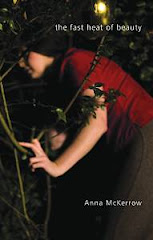
I was saddened to hear last week that Flambard Press, the publisher of my first book The Fast Heat of Beauty, have been a victin of Arts Council cuts and will lose all of their funding in 2012. Please support them by having a look at their publications and purchasing one or two! Recommendations: Peter Bennet's The Glass Swarm (a Poetry Book Society choice)and Kelley Swain's Darwin's Microscope.
Some good news came for me a few days ago when Alec Newman at Knives, Forks and Spoons press told me that among my recent sales of new book Spectral Emphatic were the University of Salford, who considered the book to contain "considerable literary merit". Ahem! Marvellous news - deeply humbled.
I've also just heard that a poem from Spectral Emphatic, Desert Sphinx, will be included in the next issue of Carole Baldock's Orbis Poetry Quarterly.
That's it for me right now - until next time...
Some good news came for me a few days ago when Alec Newman at Knives, Forks and Spoons press told me that among my recent sales of new book Spectral Emphatic were the University of Salford, who considered the book to contain "considerable literary merit". Ahem! Marvellous news - deeply humbled.
I've also just heard that a poem from Spectral Emphatic, Desert Sphinx, will be included in the next issue of Carole Baldock's Orbis Poetry Quarterly.
That's it for me right now - until next time...
Tuesday, 25 January 2011
Spectral Emphatic now available to order!
I can proudly announce that my new collection of poetry, Spectral Emphatic, is now available to order from the Knives, Forks and Spoons Press. At just £7 a complete bargain.
Here's a sneak preview of one of my favourite poems from the book, Elf-hill:
Elf-hill
I’m standing on a slip-road, waiting for the elves
on highway one. Mysteriously, the almost-bankrupt kroner
in my pocket is rolled into tight balls: I do not remember
that rounding reflex of my fingers; around us, the air slices
printing-ink and cod cheeks into a cold harmony. My pencil
hovers over the page. The bloody smell of the graphite makes
me nauseous. The Viking, a psychic and expert in these matters, is
squatting by an elf-hill around which the road parts.
This is his routine: consulting elves on plans for new roads
and intersections, settling the conundrums and drinking
coffee laced with something odourless but as warming
as the magic pounding my chakras from the
grass-covered mound. I chafe my hands, though gloved,
against the morning and yearn for an alcoholic or otherwise
effective preservative from the ghostly whims of the elf-folk,
baby thieves and hearth-cursers all, and the black moonscape,
steaming mud magic that I feel creep towards my swollen
belly, smoky fingers conjuring a jump under my
erratic diaphragm. The Viking coughs discreetly; he is ready to
dictate the elves’ terms, invoking shadows of boulders and
ice-floes and the splits in continental plates. Their demands
are simple enough: goats’ milk, bread and fresh seal meat.
My pencil moves across the page in the received
shorthand we use for such occasions, pressing sigils into the
page in the learnt language whose lines and spaces are the
windy plains in my own flat-vowelled fields of words. The
demands of the elves spread over the page like a virus:
observances to be kept with a ken of acceptance on both
sides. We will take this to be signed off, and the Viking is our
only parley, with his heavy fringe and hazel twigs.
I have never seen them, only felt their demands on my energy.
The Viking straightens from his crouch, brushing earth from his
knees, towering over the road like one who commands
lightning: it’s time to leave. As he turns, the sun hits the highway
like an alien visitation, and just for a moment the winter hillock
is alive with hands reaching for my pregnant belly, grasping
for a hold on the child-yet-to-be. I can feel their want like a
belt, squeezing spell-like promises from the foetus, promises
of the elemental to the water-bound. The Viking extends his
hand. “Don’t linger,” he says, and I pull myself away from the
lassitude that has already entered my blood like a sour painkiller,
a soused herring at the back of my tongue, dissolving.
Here's a sneak preview of one of my favourite poems from the book, Elf-hill:
Elf-hill
I’m standing on a slip-road, waiting for the elves
on highway one. Mysteriously, the almost-bankrupt kroner
in my pocket is rolled into tight balls: I do not remember
that rounding reflex of my fingers; around us, the air slices
printing-ink and cod cheeks into a cold harmony. My pencil
hovers over the page. The bloody smell of the graphite makes
me nauseous. The Viking, a psychic and expert in these matters, is
squatting by an elf-hill around which the road parts.
This is his routine: consulting elves on plans for new roads
and intersections, settling the conundrums and drinking
coffee laced with something odourless but as warming
as the magic pounding my chakras from the
grass-covered mound. I chafe my hands, though gloved,
against the morning and yearn for an alcoholic or otherwise
effective preservative from the ghostly whims of the elf-folk,
baby thieves and hearth-cursers all, and the black moonscape,
steaming mud magic that I feel creep towards my swollen
belly, smoky fingers conjuring a jump under my
erratic diaphragm. The Viking coughs discreetly; he is ready to
dictate the elves’ terms, invoking shadows of boulders and
ice-floes and the splits in continental plates. Their demands
are simple enough: goats’ milk, bread and fresh seal meat.
My pencil moves across the page in the received
shorthand we use for such occasions, pressing sigils into the
page in the learnt language whose lines and spaces are the
windy plains in my own flat-vowelled fields of words. The
demands of the elves spread over the page like a virus:
observances to be kept with a ken of acceptance on both
sides. We will take this to be signed off, and the Viking is our
only parley, with his heavy fringe and hazel twigs.
I have never seen them, only felt their demands on my energy.
The Viking straightens from his crouch, brushing earth from his
knees, towering over the road like one who commands
lightning: it’s time to leave. As he turns, the sun hits the highway
like an alien visitation, and just for a moment the winter hillock
is alive with hands reaching for my pregnant belly, grasping
for a hold on the child-yet-to-be. I can feel their want like a
belt, squeezing spell-like promises from the foetus, promises
of the elemental to the water-bound. The Viking extends his
hand. “Don’t linger,” he says, and I pull myself away from the
lassitude that has already entered my blood like a sour painkiller,
a soused herring at the back of my tongue, dissolving.
Subscribe to:
Posts (Atom)